What Cape Town’s vandalised rainbow crossing says about religious entitlement. Someone took a tin of paint to a public road and called it an act of faith. Here is what it actually cost, and who ends up paying for it.
Somewhere in Cape Town, an adult with money in their pocket, every right the Constitution gives them, the freedom to worship as they please and the vote to defend all of it, looked at a pedestrian crossing and decided their Almighty needed backup from a tin of paint. Out of everything those freedoms allow, they chose hate.
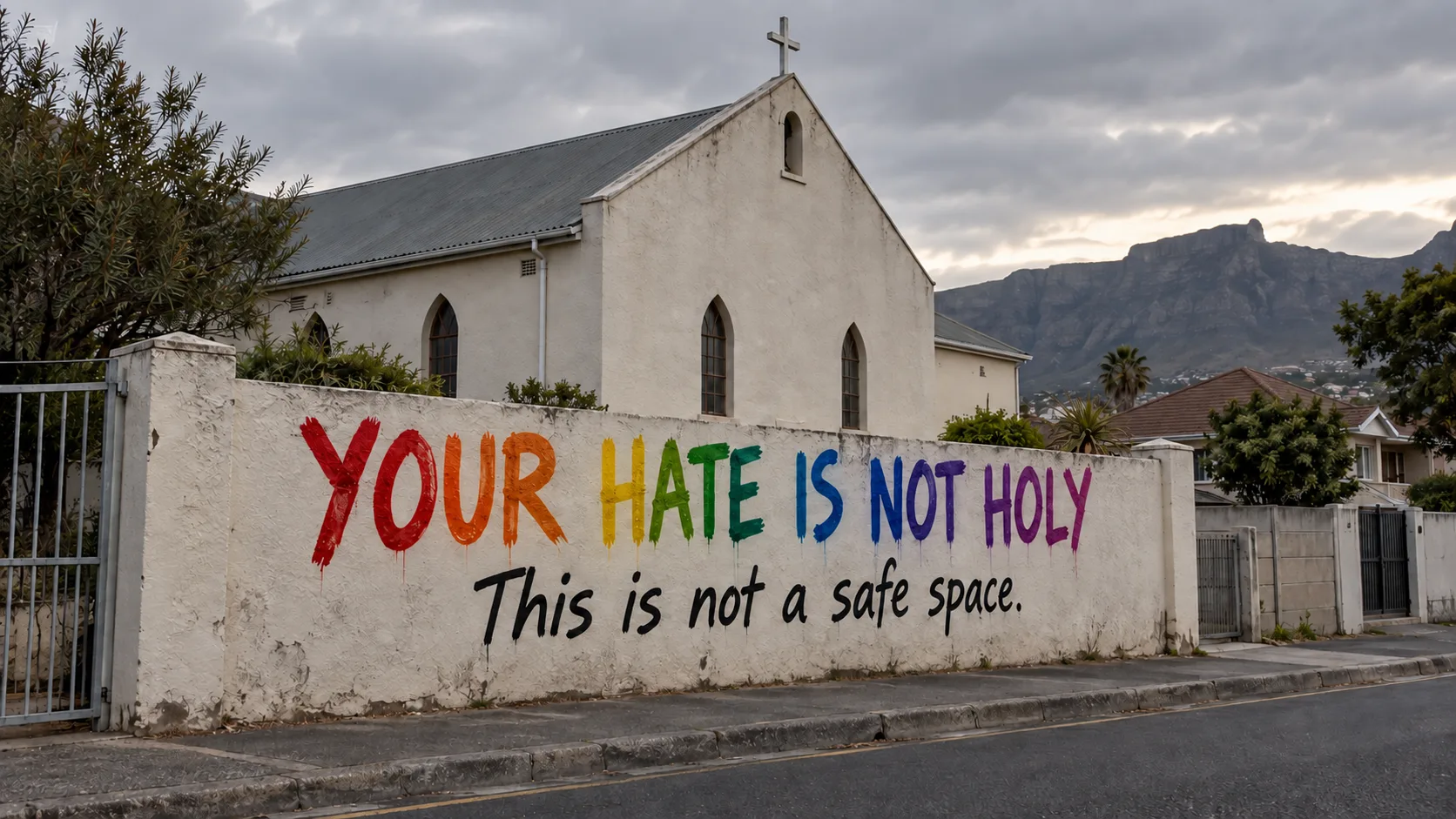
After De Waterkant’s rainbow crossing was vandalised, the City temporarily repainted it pink while waiting for the specialised colours needed to restore it. Someone then returned and wrote “Perversion, Romans 1:24–27” and “Jesus is Lord” across the surface. The crossing had been targeted twice within days.
Consider the effort involved. Find the paint. Take it to a public road. Deface a symbol that says nothing more threatening than this: LGBTQ+ people belong here too, they are safe on this street, they are part of this city, and there is hope for whoever needed to see it. Then call that an act of faith.
What, exactly, was being defended? Christianity? From six colours on tar?
I was a Christian. I am not one now. What follows is not an outsider’s complaint about a world I never knew.
This is the part I cannot understand about a certain kind of religious person: the consuming interest in what other adults do with their private parts. We (gay people) do not stand outside churches demanding an inventory of what married congregants do behind closed doors. We do not ask whether their sex is reproductive, adventurous, infrequent, joyless or non-existent. We understand that consenting adults have private lives.
Yet gay people are told not to “shove our sexuality down their throats” by people who try to write their sexual rules into our marriages, families, schools, laws and streets. Rules from their own book, a newsletter we never subscribed to.
Christian symbols occupy buildings in virtually every neighbourhood. Churches rise on street corners, crosses face public roads, bells announce services and faith-based schools teach doctrine to children. Queer people do not arrive with tins of paint to black out the crosses. We do not scrawl objections across church doors.
We understand that the existence of a symbol is not the same as being forced to obey it.
A rainbow crosses one road. Their doctrine attempts to cross every threshold. Which side is doing the shoving?
They object to our marriages as though a gay wedding somehow weakens a straight one. They object to us adopting children as though love becomes dangerous when two men or two women provide it. None of this takes a right away from them. Their marriages remain legal. Their churches remain open. Their children remain theirs, (unless they don’t want them and give them up for adoption, more on that later). The South African Constitution settled the legal principle clearly: the state may not discriminate on the ground of sexual orientation.
And since heterosexual marriage is so often presented as evidence of moral superiority, the data deserves an honest look. It does not support a neat slogan for either side. Statistics Netherlands followed couples who married in 2015. By 2025, 13.3% of male-female marriages, 12.9% of male-male marriages and 24.2% of female-female marriages had ended in divorce. In other words, male same-sex marriages in that cohort were marginally less likely to end than different-sex marriages, while female same-sex marriages were considerably more likely to do so.
That does not prove gay men are morally superior or lesbians morally deficient. It proves that marriage is a human institution, not a heterosexual (or religious) virtue. Its success cannot be read from the genders on the certificate.
The same humility is missing from the argument about children. In the United States, where useful comparative data is available, 20.9% of same-sex couples with children had adopted children in 2019, compared with 2.9% of opposite-sex couples with children. Same-sex couples were also more likely to foster. Those are US Census Bureau figures, not rainbow propaganda.
(And there is a bitter historical irony behind the adoption sermon. In 2026, the Church of England apologised for its role in post-war adoption practices in which unmarried mothers were shamed and many were separated from their babies with little meaningful choice. Religious respectability helped create some of the very family ruptures later invoked against gay parents.)
Gay couples did not create the shortage of safe homes for children. Yet they are cast as the threat while being among those willing to build families for children who need them. If the principle is that every child deserves a loving home, reducing the pool of loving homes is a peculiar way to defend it.
We are not coming for your children. But if one of your children is queer and your doctrine has frightened them into believing that death is preferable to honesty, they can come to us.
That is not melodrama. A US study of 25,896 LGBTQ+ young people found that those who had not heard their parents use religion to say negative things about being LGBTQ+ were at half the adjusted risk of attempting suicide in the previous year compared with those who had. The Trevor Project’s 2024 US survey found that 39% had seriously considered suicide in the previous year and 12% had attempted it. Young people in very accepting communities attempted suicide at less than half the rate of those in very unaccepting communities.
If they come to us, we will not “turn” them gay, they ARE gay, and they are scared. We will tell them they are not broken. We will help them find counselling, community and safety. Cape Town’s Triangle Project provides counselling and a helpline. For young adults aged 18 and over who have been thrown out or left without a safe home, the Pride Shelter Trust provides short-term accommodation and psychosocial support.
“Come to me, all you who are weary and burdened, and I will give you rest.” That is Matthew 11:28. Their verse, not ours. We are simply the ones honouring it.
The Pride Shelter says that a number of its services rely entirely on donations from the public. It would be dishonest, however, to say that no taxpayer money supports gay shelters: a separate LGBT+ shelter in Retreat receives provincial funding. Good. Queer people are taxpayers too, and public safety is not a heterosexual privilege. The larger point remains: queer communities built and helped fund services to catch young people rejected by their own (straight, Christian?) families. The children you throw into the street do not stop being your children when our community gives them a bed.
This is why we have a flag. It is not an advertisement for gay sex. It is a signal to the child in your home, your church or the back seat of your car: you are not alone. You are allowed to exist. You belong here. Your life matters. It gets better. You have a community. You have a family waiting, even if it is not the one you were born into. You can grow up.
That is also why straight people do not need an equivalent flag. Your way of life is not routinely cited as a reason to expel you from home, deny your marriage, try to change you or attack you. A straight child does not need six colours on a road to learn that adulthood is possible. Representation is not vanity when invisibility has been used as a weapon.
But a straight child might still need that crossing, just for a different lesson. Not about sex. About kindness, and what it looks like when a city decides that everyone belongs. Hate is learned. So is love. Your child will learn one of them from you.
Then there is that word on the road. Perversion.
They chose Romans 1. Paul spends that chapter listing sins his readers would enjoy hearing about. Then, in the very first line of the next chapter, he turns on them.
“You, therefore, have no excuse, you who pass judgment on someone else, for at whatever point you judge another, you are condemning yourself, because you who pass judgment do the same things.” Romans 2:1.
The verse on that road condemns the hand that painted it. They simply stopped reading where it stopped being comfortable.
If child safety were genuinely the concern, outrage would follow evidence rather than orientation. Australia’s Royal Commission recorded 4,444 people who made allegations of child sexual abuse to Catholic Church authorities, involving 4,756 reported claims. Of the 1,880 identified alleged perpetrators, 572 were priests and 693 were religious brothers or sisters. These are findings from an official national inquiry, not an accusation that every priest or Christian is an abuser.
Closer to home, the Anglican Church of Southern Africa acknowledged that it failed to respond adequately to a 2013 warning about serial abuser John Smyth, who lived in South Africa from 2001 to 2018 after abusing boys and young men in Britain and Zimbabwe. Smyth was not a clergyman. He was a barrister who ran evangelical Christian camps for boys, and in 1977 he acted as Mary Whitehouse’s counsel in the blasphemy prosecution of Gay News over a poem about Jesus. He won. The man who went to court to punish a gay newspaper for offending Christianity is why the Church’s handling of him cost the Archbishop of Canterbury, Justin Welby, his job in 2024.
None of this means religious people are uniquely capable of abuse. It means a clerical collar is not evidence of purity, just as a rainbow is not evidence of danger. Institutions that have demonstrably failed to protect children should be very careful about using children as a prop in campaigns against gay families.
And if the vandal is so preoccupied with what consenting adult strangers do with their genitals that they carry that fixation onto a public road, perhaps the perversion is not in that stranger’s bedroom but in their obsession. Who is the real pervert here?
There is another irony. We are repeatedly told that homosexuality is a choice.
When I left the church, I chose to. I examined what I believed and I stopped believing it. I know religion is not experienced as a casual consumer choice. It can be inherited, enforced and woven tightly into family and culture. But beliefs can be adopted, revised and abandoned. That is what conversion and apostasy mean.
Sexual orientation is not a creed. The Royal College of Psychiatrists states that there is no evidence for treating the origins of sexual orientation as a choice, and no sound scientific evidence that it can be changed. The irony is difficult to miss: people use a doctrine they can revise to police an orientation another person did not select.
(And do not get me started on the other abominations. The same book is just as exercised about shellfish, tattoos, mixed fabric and the sides of your beard. Others have made that argument better, and more often, than I could manage here, so I will leave it where it lies.)
How thin must faith be for two men kissing to send it over a cliff? How frail must someone’s sexuality be for another man’s marriage to feel like a personal threat? And how does the same hand remember Romans precisely while becoming biblically illiterate at “love your neighbour”, “judge not” and “do unto others”?
Religion becomes dangerous when private conviction claims public jurisdiction, when disagreement becomes sin, compromise becomes betrayal and another human being becomes an offence against God. One made, according to their own book, in His image. On a vastly smaller scale, the same habit of mind turns a pedestrian crossing into enemy territory.
So let us be clear about what was actually chosen on that road. Not the orientation. The faith was chosen. The reading of it was chosen. The tin of paint was chosen. Of everything that happened at that crossing, the only thing anyone genuinely chose was hate.
Then there is the complaint about public money. Why spend money repainting a rainbow when there are potholes?
Because that is how a society works. We all contribute to things that do not benefit us personally. Gay people without children help fund schools, maternity services, paediatric care, playgrounds and family programmes. We do not stand outside a primary school demanding a tax refund because none of the children inside belongs to us.
LGBTQ+ people pay rates, taxes and rent. We work, employ people and spend money in the same city economy. Businesses are delighted to court the pink rand when there is money to be made from us. The occasional visible acknowledgement that we also belong here is not a municipal catastrophe.
Your road remains a road. Your church remains a church. Your rights remain untouched. The rainbow is costing you remarkably little.
The vandal, however, is costing all of us. The City would not need to keep repairing the crossing if someone had not damaged it. If municipal spending is the concern, send the complaint, and the bill, to the person who arrived with scripture and paint. Better yet, send it to the church. They are tax exempt, after all. (And let us not start that conversation.)
Many Christians will be appalled by what they did. Good. Then this is their problem too. When scripture is sprayed in hate and loving Christians remain quiet, the vandal gets to present themselves as the public face of their faith.
South Africans know this pattern from another argument. When women describe what men do to them, someone always answers “not all men”. The crimes are not comparable. The excuse is. “Not all Christians” is true in exactly the same way, and just as useless, because the people who are not the problem are the ones best placed to confront the people who are. Silence hands the vandal the microphone. They will go on speaking in your name until Christians tell them to stop, out loud and to their face.
So what did this act achieve? It did not make anyone straight. It did not protect a child, strengthen a marriage, fill a pothole or bring anyone closer to God. It turned “Jesus is Lord” from a profession of faith into a territorial threat. And in a country that already carries more division than it can hold, it went looking for one more.
So, the cost. The paint is a line item. The invoice will be small enough that nobody remembers it by Christmas.
The rest is not billed to anyone. It is paid by the queer child who saw the photograph, recognised the verse from their own church, and understood that they are something to be scrubbed off a road. It is paid in belonging, by everyone who now knows which parts of this city are not for them. It is paid in lives, at the rate the Trevor Project has already counted. And it is paid by a country that could not afford another line drawn through it, and got one anyway, for the price of a tin of paint.
The rainbow crossing is not asking anyone to approve of what happens in another person’s bedroom. It is saying that LGBTQ+ people are part of Cape Town and have the same claim to its public life as everyone else.
It is also a sign of safety. To a queer person walking over it, those colours say you can be yourself here without checking who is behind you. To everyone else, they say that acceptance is the standard in this city, not a favour.