
John’s mother was convinced she had an influence on the weather. She had very bushy eyebrows that met in the middle, and her backside was the size of a small Korean vehicle. I was convinced she was hiding something. It could have been a small animal in her cleavage, a recipe for nuclear genocide, or a secret—like the fact that she had killed someone years ago by laughing too loud. She had a horrible voice and an exceptionally strange taste in music. I adored her.
At night she would play her music and dance around in the living room; she lit candles and burned incense. I especially liked it when small ornaments got caught in her dress as she swirled around the room. I was never sure if she absorbed them through her skin or if they simply became part of the dress, but they were never seen again.
I liked visiting John. He did not have any personal space, but that was acceptable for people who looked like him. I wasn’t sure if I was a normal high school student. I also wasn’t sure why John’s mother was so large and he so pretty. There were many things I was uncertain about, but I knew that I liked John in a very abnormal way for someone who lived so far away from a city with a functional theatre.
From a very early age, I was intrigued by how people decided to die, why people dressed in flannel shirts, and several other things for which my mother did not have the answers. But most of all, I was intrigued by how people got to where they were in life—why they made the decisions to get there, or here, like this town—and furthermore, how people would leave this place, be it town or life.
I have always wondered where John and his mother came from. I just remember a moving truck stopping in the driveway next door, which then gave birth to a colossal woman and her gorgeous son. I remember walking over, as if possessed, extending my hand to John and saying, “Hi, I am Markus. I will be your friend.” This was the second happiest day of my life.
John played a lot of sports—usually in tight shorts, tight shirts, and other tight things that revealed aspects of boys my age that intrigued me. I was a cliché: a skinny white person surrounded by books, who played the piano and ate alone during break time while being made fun of by boys my age who had to shave more than once a week.
Most days I would sit in the top corner of the big pavilion and think about John while watching him play—these were the happiest days of my life. I wanted to be near him as much as possible. He was a very kind soul with a calmness that radiated from his head. He had legs like a marine, arms like a builder, and a torso that looked as though it belonged in an Italian museum. His voice, unlike his mother’s, sounded like the gentle patter of light rain on a quiet lake mixed with just enough caramel in a peppermint crisp tart and the thrill you get when you see your favorite movie star take their clothes off for the first time. Really pleasant. I could listen to him talk for hours.
I had this strange feeling that John was eventually going to leave us. Maybe he had already decided to die in some bizarre manner, or perhaps he was needed elsewhere—somewhere I could not imagine. There was no other town in a 200km radius that needed the light, happiness, and other joys John provided more than this one (which had no theatre).
John scores another try.
I almost started clapping my hands in excitement but did not want to draw too much attention, so I bit down on a pencil until it shattered—leaving a taste of wood and graphite in my mouth for the rest of the afternoon. This was my first orgasm.
It was another afternoon just like that, at the end of our final school year. I was nibbling on pencils in the pavilion when it happened. At that moment, no one knew why it happened or how. John was practicing again with the other “shaving-boys.” There was a group of gangly girls sitting by the edge of the field, dreaming of wedding dresses and entry-level cars with baby seats in the back, and then it happened. John scored another try. As he rose from the grass pitch with skid marks on his knees, sweat dripping from his square jaw, and a torn rugby shirt revealing olive skin and part of a nipple, it happened—my second orgasm. But also The Hole…
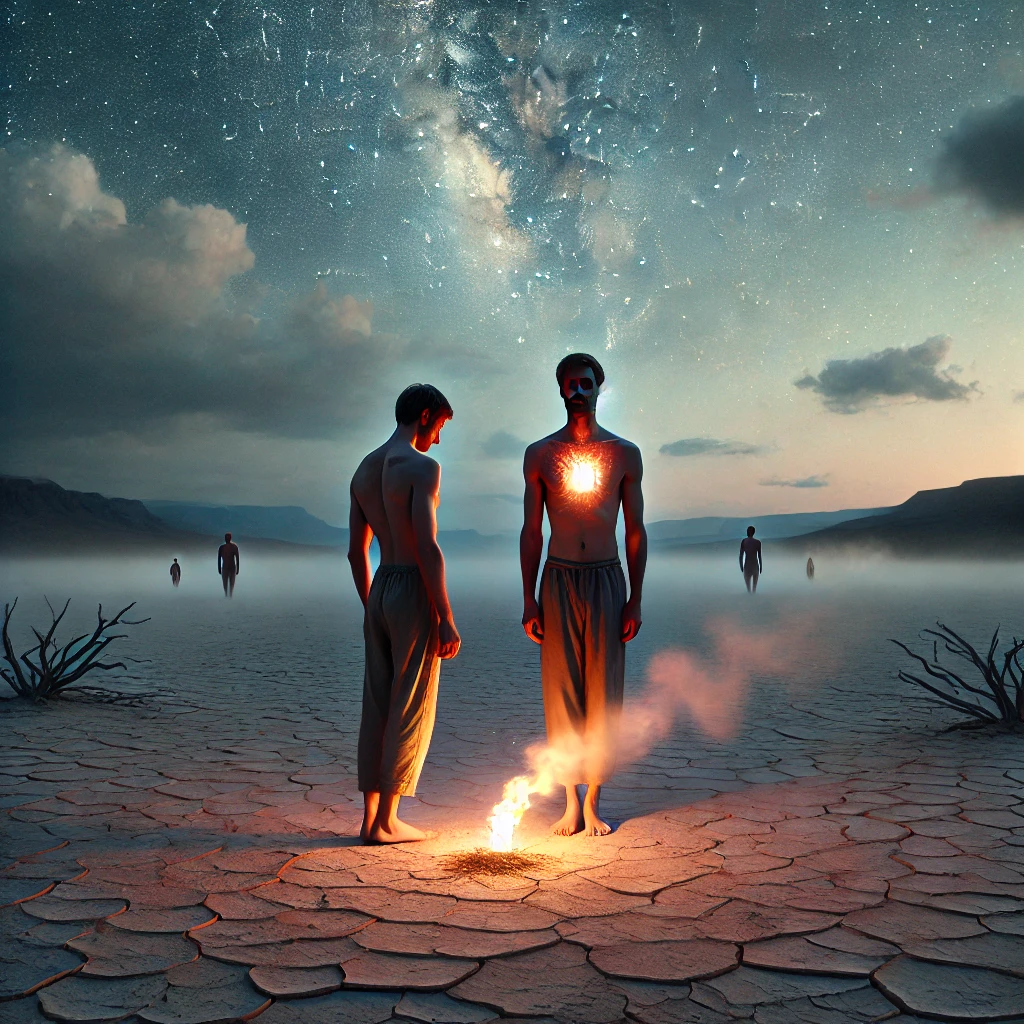
The Hole in the sky opened up. It was dark and made a soft noise, like an old modem trying to connect to the internet—almost like John’s mother when she started a sentence (she also had to connect before she could make a sound). It was a round hole, dark inside, resembling the texture of stirred black marble. I was sure it was not a black hole—based on what little I remembered from science class (because John sat next to me)—since black holes suck stuff in. This was just a hole that was also black.
The Hole remained there for days. The town was in total disarray. People were very scared. The churches became profitable again, and so did the pharmacy. Within a week, Dr. Naudé developed carpal tunnel syndrome from all the scripts, and the chemist started selling any schedule over the counter. People walked in groups from house to church to the chemist, carrying Bibles, guns, crosses, flasks, and baked goods for tea afterward. They walked very slowly because they were very high.
John’s mother was nowhere to be seen. She did not leave the house anymore. She knew—she knew about The Hole but said nothing. She did not attend church or tea afterward. Not that she ever went to church—she always said she did not like it when people watched her eat. “You know how people get when they see fat people eat?” she would say. She also said that people who prayed in groups scared her more than hell itself, and that she would take her chances when her time came.
After a while, the townspeople decided to call on neighboring towns for help. The local poet, a scientist, another preacher, and a medium were brought in from the big city to help explain The Hole in the sky. People were getting on edge—some started buying canned goods in bulk, some started drinking, some began having lots of sex with people they were not married to, and some repented. The church and the hotel made more money than ever. Everyone shouted “Oh my God!” the whole time.
I was devastated. My world had been turned upside down. It was not so much about the fact that there was a hole in the sky that possibly threatened our way of life, or that the town might be in danger—it was that I could not care less about this traumatic excuse of an existence. If anything, I would have been delighted if this were the end… I was angry at how this hole changed my interactions with John. No more sitting on the pavilion chewing HB pencils, no more John invading my personal space during lab time in science class, no more walking two meters behind John on our way home, and no more sitting on his bed talking about what we would do once we left this town—or life. John was my only friend. My life was over. I hoped that this hole would do what it had come here for, whether that be death or the rapture I had been praying for ever since I accidentally saw Magdaleen Fourie naked.
After weeks, the effects of The Hole on the town reached a breaking point. News spread to neighboring towns, and people started talking. Trucks refused to come into the town to restock supermarkets. We ran out of fuel, water, antidepressants, and most of all, patience.
The Martens woman who managed the cat shelter was the first to speak up at after-church tea. “Where is that large woman? The one with the dial-up voice and the pretty son—what’s his name, John, is it? Why isn’t she here?”
“Yes,” said another, “she is nowhere to be seen; she must know something. I heard strange music coming from her house. Have you seen all the succulents in her garden? It is not normal. We must fetch her.”
“Yes!” they all yelled. “But who will fetch her?” said Milk-Marie from the salon.
I did not hesitate. “I will! I will fetch her,” I yelled. The whole room turned their gaze to me. I had never felt this uncomfortable in my entire life (except for the Fourie girl incident). But it was all worth it, I thought. I might see John again. It was all I wanted during this time of The Hole.
“No surprise there…” mumbled Fifth-Try-Ferdie, looking at me as if I were some deviant. My father poured whiskey from a flask into his coffee. My mother drank a few pills she had found in the lining of her handbag.
People called Ferdie “Fifth-Try-Ferdie” because he was on his fifth wife. The previous four had killed themselves in the farmhouse kitchen. No one knew why. No one asked. Vivian, or Fifthian, as people called her (behind her back), was the most anxious woman I had ever met. She only found out about her predecessors’ fate one year after she married Fifth-Try-Ferdie. She never baked or cooked; she only ordered ready-made meals from a bored houseman two farms down the road. She would never see the inside of a kitchen again.
As I walked over to John’s house, I thought that maybe John’s mother did, in fact, have an influence on the weather. Perhaps she could control things, but I was not sure if this hole over our town was weather-related… but if anyone knew anything, it had to be John’s mother. I agreed—the music and the disappearing objects must explain something, and compared to the other people in this town, she was definitely the closest to ascension. I did not see God having any business with the rest of these people.
After all, the scientist left after only two days, the preacher rejected his faith after only two days, and the poet developed yet another existential crisis and was drinking with the preacher in the bar. John’s mother was our only hope. I hoped John would open the door.
I knocked a few times. Nothing.
I knocked again. I heard footsteps on the creaking wooden floors in John’s house.
“I can hear your steps,” I said. “Open the door, please, John—I need you… we need your mother.”
The door opened slowly, and John appeared in the doorway, the late afternoon sun rolling off his shoulders. He was shirtless, as if he had just come from the shower, wet—so was I. Silence.
“Egghmmm… John, hi, we need… your mother. At least Milk-Marie and Fifth-Try-Ferdie think they do. It’s about The Hole.”
“Whose hole?” John looked confused. So was I.
“Yes, no!” I said.
“No what?” said John.
“I mean The Hole in the sky. People have questions, and they think your mother can help.”
“Why would they think that?”
“I don’t know—well, I do. They think it’s because of the music and the incense and the…”
“I’ll call her.”
John walked down the hall, water droplets shining on his back.
I started crying—this was not how I wanted to die.
As John and his mother walked through the long hallway to the door, I could hear her voice connecting—a muffled “… knew this day would come… fucking Gypsy… no one likes ugly children…” She had a duffel bag flung over her shoulder.
I was more confused than ever, but also happy, as John only put on a vest with his short shorts. I walked one meter behind them.
As we arrived at the church hall, emotions were running high—screaming, shouting, and crying. The Martens woman was standing on top of a table like a conductor, waving her arms as she spilled tea on everyone.
“There she is!” shouted Fifth-Try-Ferdie’s wife, choking on a tranquillizer she was trying to chew unnoticed.
John’s mother walked into the chaos, raised her arms, and said, “Relax, they are here for me.”
“Follow me,” she said. “They need open space to perform the extraction.”
A stunned silence fell over the church hall. Everyone followed John’s mother as she walked in the direction of the high school.
We arrived at the rugby field, where John’s mother walked to the middle of the pitch. Everyone stopped walking once they reached the chalk line, as if in spectator mode, with The Hole visible right above the field. It was as if it started pulsating with the gathering energy.
John tried to stop his mother—confused, scared, wanting answers from her—he tried to pull her back. She turned and took his face in her fat hands and said, “I’m indebted to the Skies—I’ve made a deal. Beauty comes at a price… I love you; now say goodbye and leave this town. I must go. There is nothing here for you. Take this bag; everything you will ever need is in here. Pick a city and go there. Keep in contact with Markus—he is not like the others.”
As she raised her arms again, she made the dial-up noise. The Hole opened wide, turned bright white, and light reached down and touched the top of John’s mother’s fingertips. Then the strangest thing happened… The Hole sucked what I can only describe as a goddess from John’s mother’s skin.
A queen, extracted from the lard of fat, rose up like some angel. She floated above our heads, gleaming.
“I have sold my looks for yours, my son. Please use them well—beauty is not skin deep; it’s covered in layers and layers of fat.”
“Please leave this ugly town.”
John left. The Hole closed. The town breathed again, pretending nothing had happened. I sat on the pavilion, waiting for the sky to split open once more. But it didn’t. It never would. And I understood—some people get extracted. Others stay behind to rot.
I walked home, packed a bag, and left that night. No light, no sound, just my shadow stretching long beneath the streetlights. If The Hole had come for John’s mother, maybe something else would come for me.
I couldn’t take any risks.
Maybe I had to go find it myself.